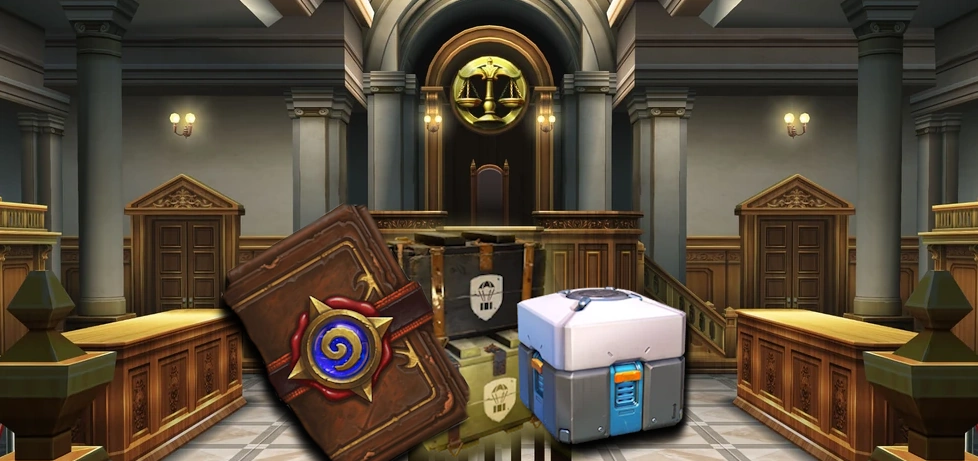
A judge in Brazil has fined Blizzard around US$ 3.5 million for selling loot boxes to minors in Hearthstone, Overwatch, and four Call of Duty titles.
The fine is part of a broad set of decisions against many large game companies or platform holders like Riot Games, Tencent, Apple, Microsoft, and many more. According to local reports, these companies are being fined about US$ 65 million (R$333 million) in total, given current conversion rates.
Judge’s Ruling
The ruling seeks to impose four obligations on Blizzard and the other companies.
- Pay the stipulated fines to a public Youth Defense Fund (Fundo dos Direitos da Criança e do Adolescente do Distrito Federal).
- Compensate affected minors who come forward and prove their claims.
- The ruling doesn’t define a value, but it opens the door for individuals to seek reparations from the companies.
- Apply a list of changes to their games within 90 days. (Details below)
- Publish the ruling to their audience, both on social media and inside the games.
Microsoft, as a company, is being fined twice by the ruling, both as a platform and as a publisher. When sizing the fine, the judge explicitly cited Microsoft’s acquisition of Activision Blizzard. In total, Microsoft is being fined around US$12.6 million (R$65 million).
In-Game Changes Requested by the Courts
As part of the ruling, the judge requested the following reforms to the games from the publishers in question:
- When purchasing Loot Boxes, warn users about the RNG nature and its prohibition to minors.
- Every Loot Box must display its exact odds at the purchasing screen.
- Implement robust age verification, minimizing data collection.
- Offer free refunds to guardians for purchases made by children without their authorization.
Heart of the Matter: Gambling for Children
The case was brought by ANCED, a national association of child and adolescent rights defense centers, which argued that loot boxes have been used to sell gambling aimed at children, disguised as a game feature.
The judge’s core finding is that loot boxes behave identically to classical gambling. You pay something, the outcome is uncertain, the house controls the odds, and you might get something valuable or worthless.
The filed complaint is based on two pillars, argued by ANCED:
- Abusive advertising directed at children
- Defective and Deceptive Service
The first pillar is based on the presentation created around loot boxes. Loot boxes, in general, offer flashy animations, are offered during seasonal, limited events, and many times require multiple purchases to complete a collection. These factors exploit kids’ underdeveloped judgment and inexperience. Brazilian consumer law bans advertising that preys on a child’s deficient judgment.
The second is around their mechanics. The companies cited in the case, including Blizzard, never disclose the real probabilities of getting each item. That information and the mechanics around the randomness of the boxes are opaque. There are also no warnings about psychological risks involved in the systems. Under Brazilian consumer law, it is classified as a “defective service”, triggering strict liability without the need to prove intended harm.
The judge found that these pillars aren’t bugs in the systems; they are their very features, and the systems are created with them in mind. This conclusion was reached with the “help” of Activision Blizzard.
Registering a Patent for Encouraging Gambling?
The “help” from Activision Blizzard came from a patent registered all the way back in 2017. The patent, US 9.789.406, titled “System and method for driving microtransactions in multiplayer video games”, details a framework designed to use matchmaking algorithms to influence players into making in-game purchases. This has been a controversial patent ever since its registration by Activision Publishing. Activision claims it was just a patent and never used in their games.
The existence of this patent is being used as a basis to deny any “we didn’t know”, as it explicitly describes an ecosystem engineered to encourage players to spend. The patent consists of a company formally registering with the government a technique inducing players to buy. The judge considered this as evidence of systematic and intentional predatory design.
Consumer Protection
In her ruling, the judge emphasized that the companies are not being criminally prosecuted for illegal gambling. This is a civil action to enforce consumer and children’s rights.
Current Status and What Comes Next
The case has been running in the Brazilian courts since 2021, and the first ruling has been reached. Blizzard and the other companies cited in the lawsuit may still appeal the decision in the following weeks. The case will likely drag on for months, if not years, before it finishes.