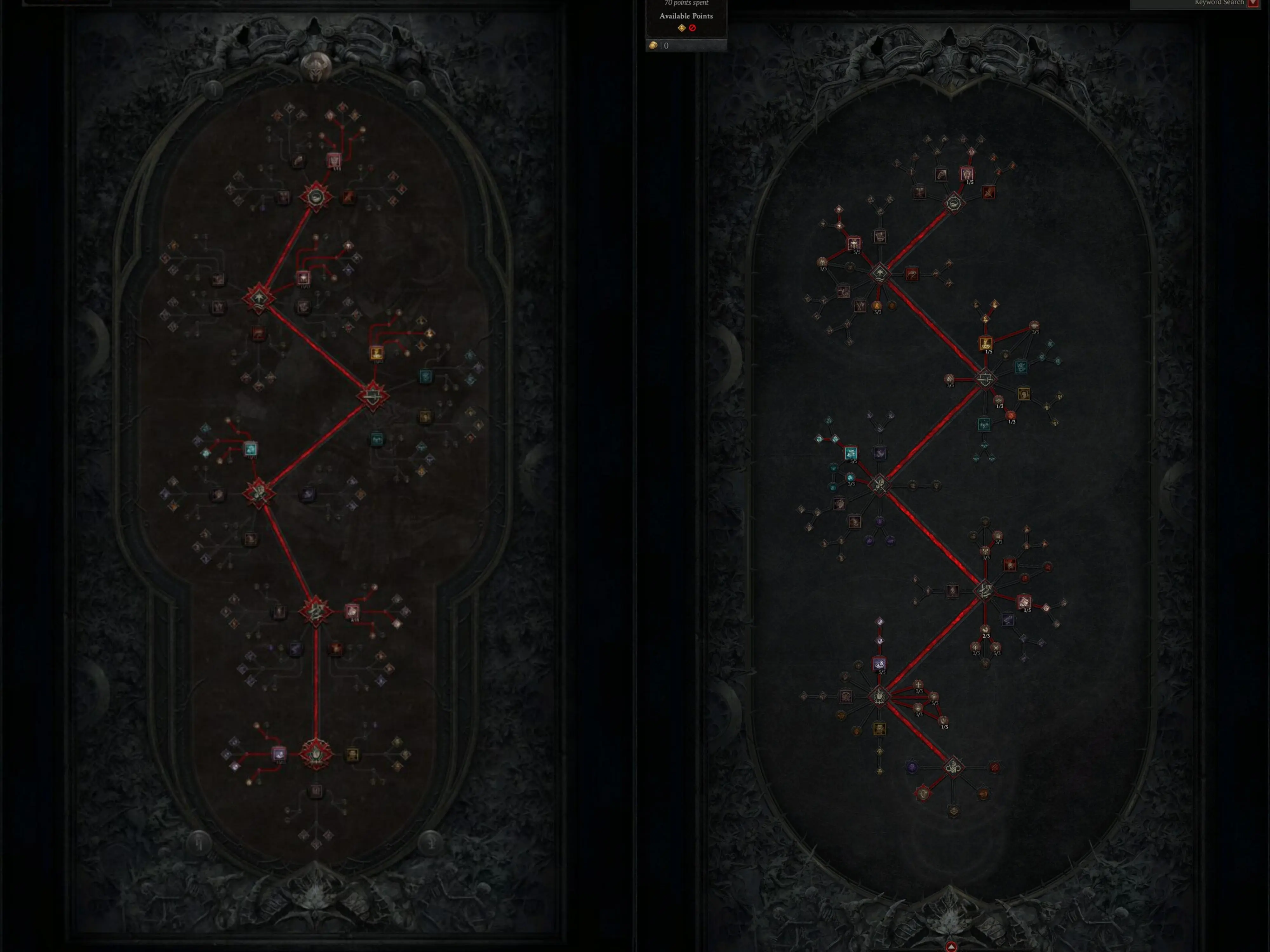
As Lord of Hatred approaches, the community is getting its clearest side-by-side look of the newly reworked skill trees yet. A new Reddit thread in r/Diablo is breaking down exactly what changed for the Barbarian. The verdict? It is a massive upgrade, but some players are already side-eyeing how it will actually play out in the endgame.
What Actually Changed
The old skill tree allowed players to choose a skill and two major modifiers to choose between. That was it. This was a clean, simple approach that yielded an obvious “correct” choice once the meta settled.
The new system blows that wide open. Each skill now offers three major modifiers plus two sets of two additional modifiers, meaning each skill has as many as twelve possible combinations. This is a huge jump in potential build permutations, before you even touch gear or Paragon!
The original poster points to Rend as an example of the newly possible customization. Previously, Rend was a slashing bleed attack with a vulnerable upgrade. Now, Rend can be reshaped into a Fire damage skill, have its range extended, send waves, or combine several of these effects, depending on how you allocate nodes. It is still Rend, but it feels like four different skills.
Passives Are Gone
One of the biggest structural changes players keep circling back to is that all passive nodes and key passives have been completely removed from the skill tree. The tree is now exclusively about customizing how your active skills behave. Blizzard has hinted that some build-defining passives will make their way into other areas, like affixes on gear, Paragon, and more. For many commenters, this is the change that makes the new system feel truly different rather than just “the old tree with more dots on it.”
The Diablo III Comparison
Several players in the thread made the same comparison: the new system functions like a refined version of Diablo III’s skill runes. You pick an active skill, then have the option of transforming that skill’s element, shape, or other functionality. The key difference players are highlighting is that in Lord of Hatred, multiple modifiers are layered at once. This allows more agency than Diablo III’s “pick one rune” approach.
The Illusion of Choice?
More choices are great, but as commenters point out, twelve combinations per skill can quietly collapse into a single “correct” option once the math gets solved. Meta builds always emerge, and any new modifier that does not get matching support from gear, Paragon, or just clean gameplay will get dropped the moment something stronger exists.
Our Take
This looks like the most ambitious progression change Diablo 4 has made since launch. Pulling passives out of the tree and pushing all the agency into active skill customization is much more than a cosmetic rework. Whether it ends up feeling like twelve real options per skill or two-plus-ten-traps is something we are only going to know once Lord of Hatred is actually in players’ hands.
Stay up-to-date with everything Lord of Hatred as we rapidly approach release day by checking out our Diablo 4 news hub.