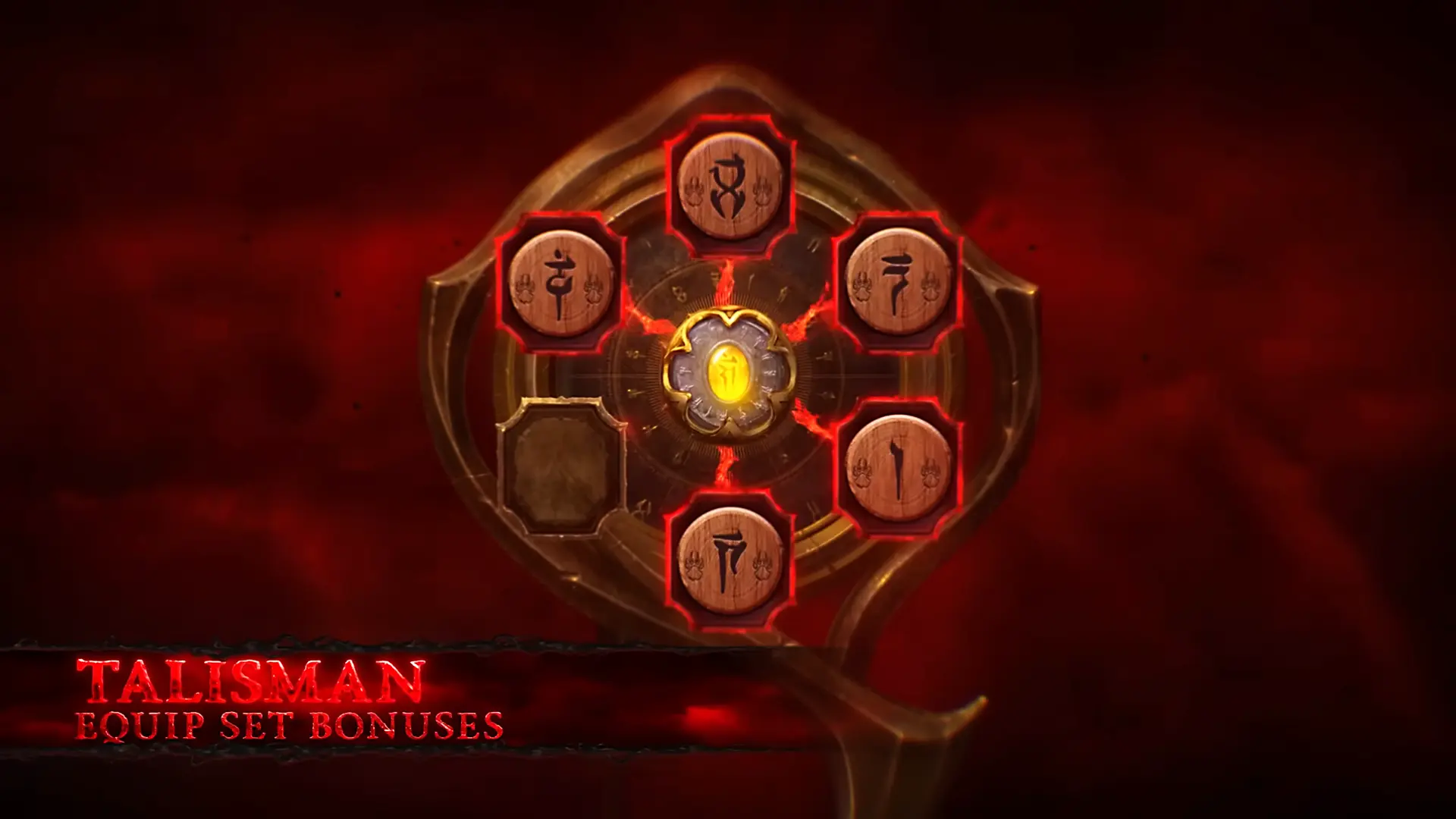



With Lord of Hatred, Diablo 4 is bringing back something long associated with the franchise. Known as Talismans, they are supposed to be similar to set items. Although this was not entirely confirmed, early information does hint towards something like that.
On paper, that alone is enough to divide the community. For some, it is a return to better build identity and long-term goals. For others, the memories of Diablo 3’s extreme power creep have not faded.
But once you take away the nostalgia and the trauma reactions, the debate is not really about “sets vs no sets”. It is about how power is delivered.
Keep in mind that we do not have much information about Talismans yet, so all of this is purely suppositions and expectations.
Why Set Items Worked, Until They Did Not
Set items historically did two things very well:
- They gave direction with a clear build goal that players could work toward
- They made characters feel complete once the set bonus was activated
That worked in Diablo 2 because sets were mostly sidegrades. Two or three pieces could smooth out a build, but endgame power still came from smart item combinations, not mandatory bonuses.
Diablo 3 changed that equation. Once six-piece bonuses entered the picture, sets stopped being an option and became requirements. If you wanted to play a skill, you played the set. Damage bonuses spiraled into the tens of thousands of percent, and gearing choices effectively vanished.
That is the fear resurfacing now.
The Main Risk: Damage Multipliers Over Gameplay
Most criticism around Talismans boils down to the concern that raw damage bonuses will kill build diversity.
When a bonus reads “Skill X deals +40,000% damage”, everything else becomes irrelevant. The game stops asking how you play and only checks if you equipped the correct pieces.
Many players are not asking Blizzard to remove power, but they are asking them to move power away from numbers and toward mechanics:
- Extra charges
- Skill behavior changes
- Elemental conversions
- Positioning trade-offs
- New interactions rather than raw scaling
Those systems would create variety without turning Talismans into mandatory win buttons.
Talismans Might Avoid the Biggest D3 Mistake
One important difference would be that Talismans reportedly do not occupy regular gear slots. Instead, they appear to function more like a separate system, so closer to seasonal powers or a dedicated charm interface. That is an important part.
If Talismans do not replace gear, ring, or weapon slots, they are less likely to invalidate existing itemization. Players can still chase Uniques and Mythics without feeling like non-Talisman drops are automatically worthless.
This alone removes one of Diablo 3’s biggest problems, where you had entire loot categories becoming irrelevant overnight.
What Players Want
Under all the arguing, some expectations are the same for everyone:
- Clear progression goals are good
- Locking 5-6 pieces for one bonus feels bad
- Gameplay changes are more interesting than numbers
- Endgame already has “best-in-slot’ problems, and Talismans will not magically fix or ruin that alone
The real hope is that Talismans add options instead of replacing them.
Talismans do not need to be best-in-slot to succeed. They need to be interesting enough to justify existing.
If Blizzard treats them as another damage lever, the system will burn out fast. If they are treated as a way to modify skills, open new archetypes, and give players reasons to experiment, even off-meta, they could become one of Diablo 4’s strongest features.
For now, excitement and concern are both justified. Everything depends on Blizzard!
For more guides, tier lists, and information, check out our latest news!