On February 25th, Icy Veins had the privilege to sit down with Game Designer Jake Shillan and Senior Game Designer Kim Flack to ask a variety of questions about the Midnight expansion that is to launch in just a few hours! As experts on both the Prey System and the design of the new Zul’Aman zone in Midnight, we had to poke them with a bunch of questions to find out more about what awaits us in Midnight.
We’d like to thank Blizzard Entertainment for granting us this chance to pose our most burning questions, and to Jake and Kim for joining us for this Interview!
Interview Participants
- Kim Flack (she/her), Senior Game Designer, One of the Main Designers for the Prey System
- Jake Shillan (he/him), Game Designer, Zone Lead for Zul’Aman
- Kathryn Budwit (she/her), Guide Writer at Icy Veins, Executive Director of VISAGE
- Jörn Thieme (he/him), Icy Veins Section Manager for Retail WoW and Guide Writer
Interview Summary
Here are some of the highlights of the interview:
Forest Trolls and the Amani Tribe
- The team played archeologist and historian, looking back at some of the first appearances of the Amani, reaching as far back as Warcraft 2. Figuring out why Zul’jin acted in the ways he did and the experiences that shaped him, and how he became such a polarizing leader, was an important step in eventually bringing the Amani Tribe to life in Midnight.
- Across all the Troll Tribes that spread out from Zandalar, the Amani are considered the mother-tribe of all Forest Trolls. After a schism occurred in the past, smaller groups of Amani splintered off to create their own tribes. With Midnight, we get to see the Revantusk, Shadowpine, Witherbark, and the Vilebranch Trolls in Zul’Aman, alongside the Amani Tribe itself.
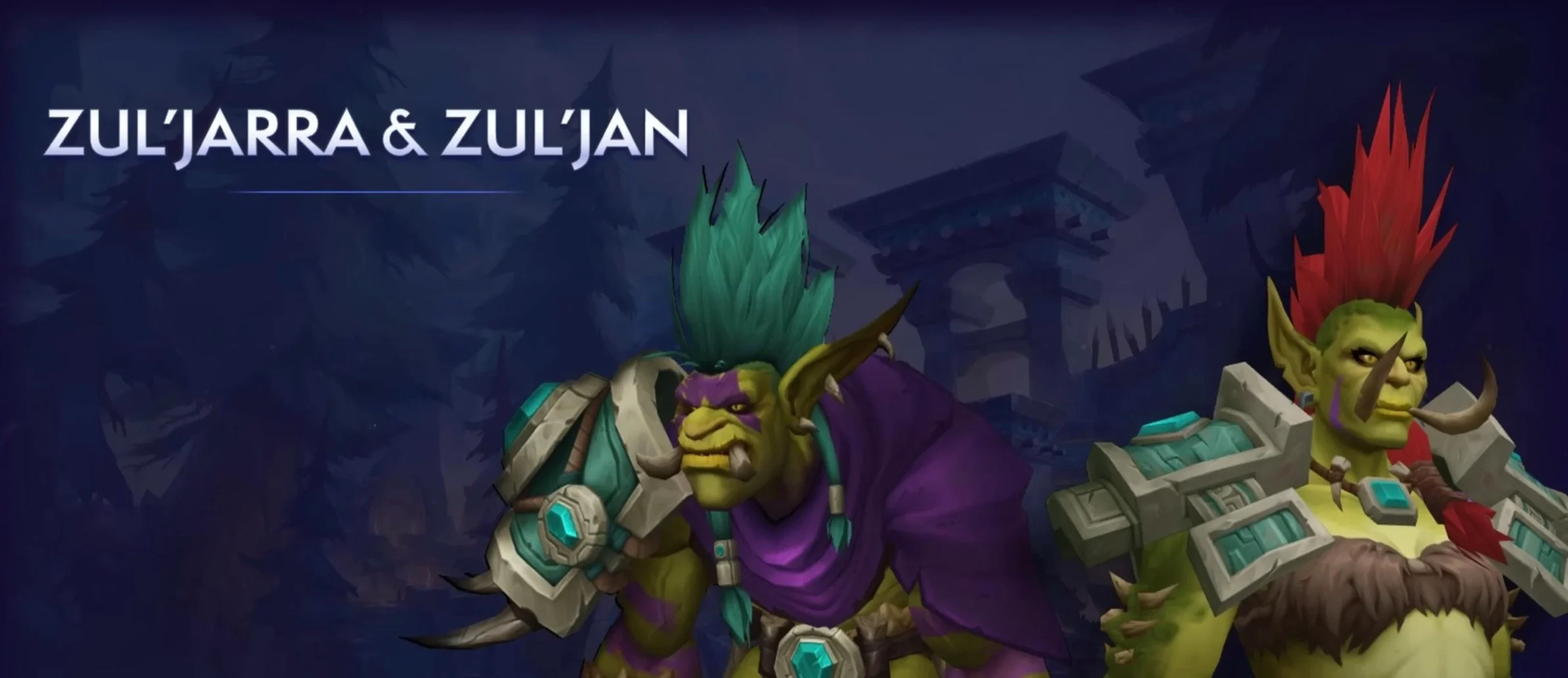
- We’ve only ever encountered the Amani as enemies so far, and finding ways to humanize them to some degree, despite the atrocities they have committed in the past, was a challenging task. Thanks to the guidance of the pragmatic Zul’jarra, Zul’jin’s granddaughter, as well as her brother Zul’jan, the Amani recognize that the enemy of their enemy could be their friend.
- The team hopes that players see the Amani as an intriguing faction, not just as the evil trolls from the past, and that players want to learn more about them now that we have managed to find some common ground in our fight against Xal’atath and the Twilights Blade.
- Dundun, the Loa of Abundance, has many great rewards in store for players who want to engage with the Abundance Event, including a special reagent to craft the best profession gear!
Zul’Aman and its Secrets
- With multiple tribes of Forest Trolls present, the team was able to create unique areas and stories, developing each of the tribes independently, even if they might all be Forest Trolls at their core.
- Exploring the relationship of the other tribes and the Amani was one of the goals for designing the zone. Giving a unique identity and credence to each of the tribes was important for giving color to Zul’Aman as a zone.
- You may want to be careful about flying into Zul’Aman if you have not yet made contact with them through the main-story. The Amani do not take kindly to unknown intruders!
- A secretive temple can be seen off the shore of Zul’Aman. The Amani take great pains to stay away from it, claiming that it is incredibly dangerous to venture there. But it might hold a mysterious treasure or a certain sword – if we ever get to explore it. 😉
Prey System
- The Prey System is an attempt to bring the bite-sized content that is Delves, into an open-world context where players can still play at their own pace.
- The scaling difficulty aspect was an important piece of the puzzle, allowing players to engage in new aspirational content in a new environment, while retaining the aspects that made Delves, Mythic+, and other features so enjoyable.
- The Affixes of the Prey system are meant to provide an extra layer of difficulty, adding additional challenge to a player’s moment-to-moment gameplay decisions.
- With many different Prey targets available, there will be a wide variety of challenges, on top of the affixes, and players are expected to use all their class’s skills and even racial abilities to deal with the challenges they offer.
- Some Prey Hunts may play out differently depending on difficulty, with Nightmare difficulty potentially altering abilities of enemies, on top of giving your Prey target more health and damage.
- Each Prey target has their own personality, which is reflected in their fighting style and abilities.
- Nightmare difficulty Prey hunts are expected to be around the same difficulty as a Tier 8 to 11 Delve boss. So far there are no plans for a Prey Nemesis boss, but the team is very open to hearing how the community wants the Prey system to evolve in future patches.
- Combat and Encounter designers are mindful of the changes to the Add-on landscape, and we might see fewer abilities thrown at players in any given pack of enemies.
Full Transcript
The below responses have been edited slightly for readability purposes.
Icy Veins: We didn’t really get to see much of the Amani before Midnight — ever since the original raid almost 20 years ago. How did you go about developing a history for them, while Azeroth was in turmoil through so many different crises?
Jake Shillan: Yeah, it’s a question that we kept top of mind throughout all of pre-production and production. Essentially the Amani are a very unique case, because they’ve been in the Warcraft franchise for a long time, even back in the RTS days.
In Burning Crusade, they had a huge role, but mostly that was Zul’jin and the Amani as enemies. When we first started in terms of Midnight, we had to play archeologist; we had to play historian; and we had to dig through what was available in canonized Warcraft about the Amani. I think one of the most interesting things we found was this very iconic sect of trolls with a very iconic character Zul’jin, as most of the histories and lore is from the perspective of other cultures. The Zandalari goes super far back into the histories, right?
But more recently, humans, Blood Elves, and, of course, the adventurers at large, in terms of the Burning Crusade. And so, we sort of reverse-engineered and extrapolated all the information we could to fill in the blanks and create context for this culture.
Because even though they existed, we wanted to give them the depth that an entire new zone’s culture deserves, right? And it usually came back to questions like, “Okay, why did Zul’jin do what he did?” Not just within his own lifetime (what sort of context came from there), but the historical context. What about the Amani led to the birth and growth of someone like Zul’jin? Because that’s who we have the most depth on in terms of character.
It’s honestly just a great journey; I’ve always been a fan of Zul’jin as a player, so this was a nice deep dive into it. And I think that we really gave that variety, that depth, and that character to the Amani trolls that they haven’t quite got yet.
Icy Veins: When it comes to the troll tribes, there’s always quite a few of them. If we recall correctly, we also encounter the Witherbark and Vilebranch tribes in Zul’Aman. What made them so special that they join the Amani and are represented in Zul’Aman. How did that influence some of the environmental design and storytelling?
Jake Shillan: Early on in our pre-production, as we were discussing sort of the — not just the stories, right — but also the very areas of the zone, the cultures within the zone; there were a lot of discussions surrounding the fact that the Amani tribe is sort of this origin or mother tribe of all forest trolls.
Not every troll is the same. A Darkspear Troll; a Zandalari Troll; a Gurubashi Troll; they all were spread out so long ago from original Zandalar into their own areas of the world. And the Amani, for so long, were these you know forest trolls. But every forest troll was an Amani Troll, and then at some point, in the past, there was a schism where there were smaller groups that branch off from the Amani, right?
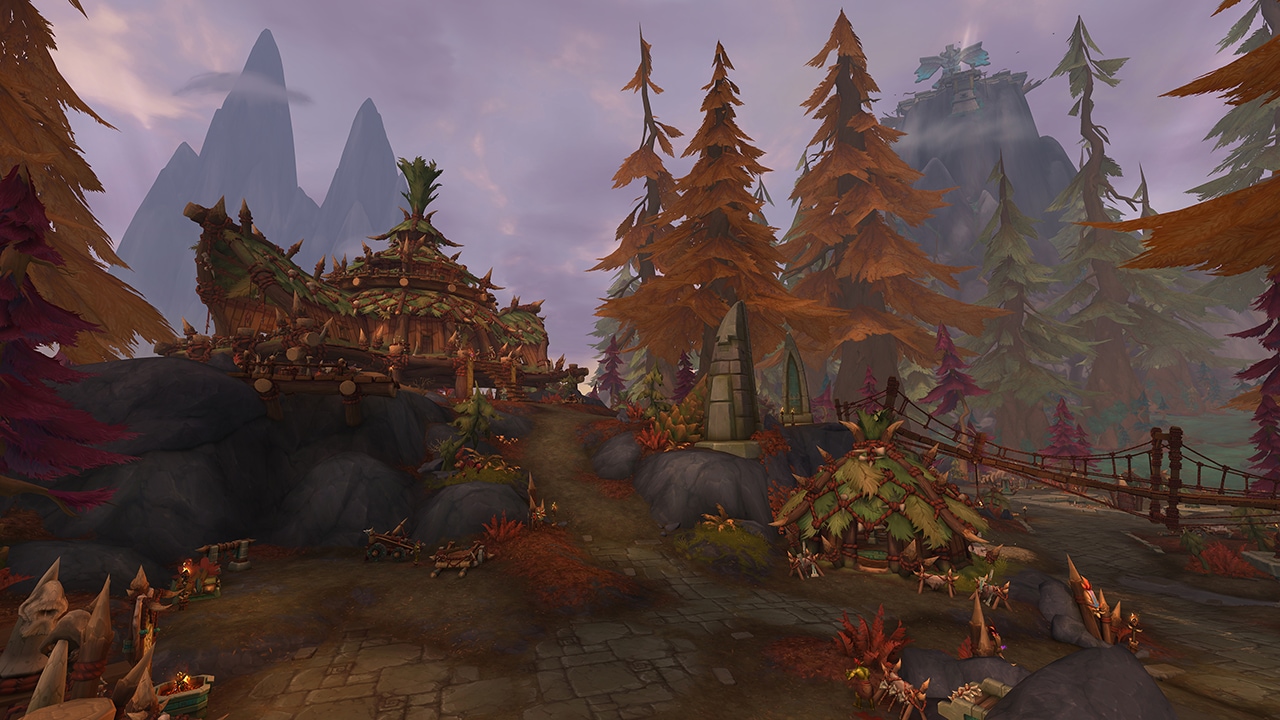
So this conversation kept coming around, of like, “How do we, sort of, put them into this whole zone that is essentially… It is Zul’Aman, it is the Amani… but it is also the forest trolls right?” And so, at some point, we decided like, “Okay, let’s give identity and credence to each of these tribes.” We sort of boiled it down to the ones that we felt were pretty well-known. So it’s the Witherbark, the Shadowpine, the Revantusk, the Vilebranch, as well as the Amani. And they all live under the greater umbrella of the Amani tribe: they’re all forest trolls, but they each have their own unique identity.
And so, it started out as an idea about how to present these other forest tribes that definitely have existed. Like, we didn’t want to just ignore them and pretend they didn’t exist — we wanted to show their relationship to the Amani. It started out as like “Okay, an answer to that question is…” and it became this bounty that we’d sort of keep going back to.
Because it allowed us to show the many dimensions of these trolls that — again — we’ve known so long who they are, but now’s our chance to get really intimate and engage with them on a personal level. And so it ended up becoming the source of starting conversations like, “Okay, what is this village area? What is this hub area? What is it about?”; “It’s about the Witherbark”; “Well, what about the Witherbark that’s different from the Amani?”
Being able to make those decisions, and then create from those decisions, led to something that sort of is like a very diverse area… even though each of them are all Amani trolls.
Icy Veins: So when it comes to the Amani, you’ve mentioned earlier as well, we’ve always had this viewpoint of them as a hostile faction — at all times — and they’ve committed many atrocities in the past. So you now have to humanize them to some degree. We give them leaders that we want to talk to and ally with; that must’ve been a very interesting challenge.
So how did you go about carving out specific locations, quests, or environmental storytelling spaces to help players start to not just look at them as bad guys, but more somebody who we’ll need for the challenges to come?
Jake Shillan: Yeah, good question. Essentially humanizing them is the key part. Because we don’t just want you to not see them as enemies. We wanted to take it a step further: we want you to be interested in their stories.
For the key Amani characters of Midnight, which are Zul’jarra and Zul’jan, they’re siblings; they’re the grandchildren of Zul’jin. This is their first appearance.
There’s been a lot of time in and out of game, between when we did the raid originally in Burning Crusade and now. We sort of utilize that time in the storytelling to say: “Okay, you know what? After the adventures came through, the champions of Azeroth, and they beat all the Amani; they slayed Zul’jin; they slayed Malacrass; and got their epic pants and their bear mount…” The Amani receded. They withdrew.
So, there’s no truce, there’s no peace treaty or anything like that between the Eversong Elves and the Amani Trolls: it’s just that things have been quiet.
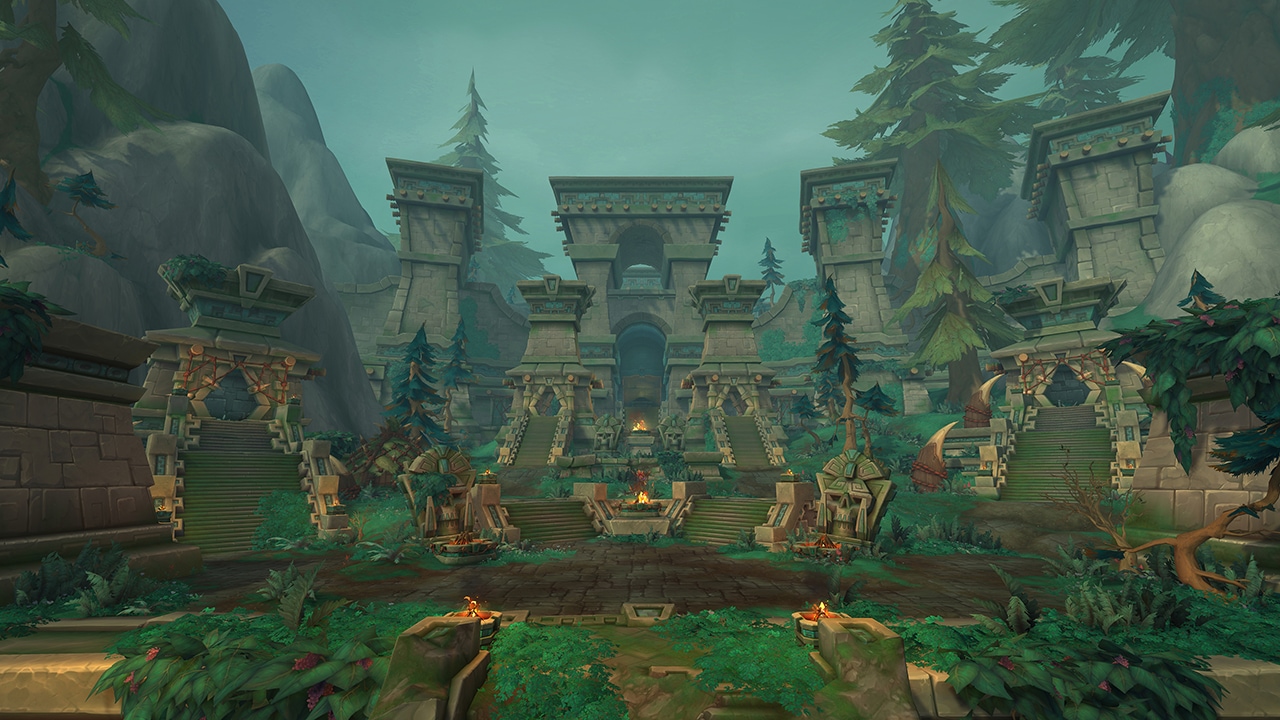
And so when Midnight begins, Xal’atath shows up and the Twilights Blade invade Zul’Aman and Eversong. It creates this situation that says, “The priority isn’t you. The priority is The Void”. And that doesn’t mean, “Okay let’s all be friends and forget everything.” That truly does mean like, “I don’t have time to worry about you.”
And that is Zul’jarra’s perspective, right: she’s very pragmatic; she’s for the Amani; she’ll do anything for the Amani. But she’s pragmatic. So when — I won’t give any spoilers 🤐 — but when you get to the point in the story, where you set foot into Zul’Aman, Zul’jarra is looking at you like, “If you want, you’ll have a spear at your back, and every Amani will be staring daggers at you. But if you want to perish on our battlefield, sure, go ahead. I don’t have time to worry about you.”
So that is sort of the cornerstone, the foundation of what will end up becoming a wide array of stories and characters that we get a much deeper introspective look into. And that hopefully becomes something where players go, “Okay well, I want to see more of the Amani.” Like, “I want to see more Amani stories”; “I want to see more stories about Zul’jan”; “I want to see more stories about Zul’jarra”; “I want to see more stories about Dundun”.
(Whispers) The Loa of Abundance, but we can get around to that later.
So yeah, to answer your question more specifically… I think the process is always an investigation until like, “How can we make characters and stories that are so appealing and fit within the grounded reality that is: yes, you were once enemies with my people. But there’s a bigger problem; we can deal with our issues later. I gotta deal with this, hold on.”
Icy Veins: And we’d imagine not everybody is immediately okay with that either.
Jake Shillan: No, no; for instance, let’s say that you were to fly over the wall — yes you have a flying mount, you can go wherever you’d like now, including Silvermoon… 😉 Enjoy that by the way, being able to fly around Silvermoon.
But if you hop the wall between Eversong and Zul’Aman and in your Warband… If you’ve never entered Zul’Aman and haven’t gotten so far in your campaign, they will not be friendly to you. You will probably not be able to engage with them; you will certainly be locked out of local stories and stuff like that. And if you try to go into the villages, the guards may have a problem with you. So watch out. (Laughs)
Icy Veins: So Jake, you’ve mentioned it already, the Loa of Abundance. The Abundance Event itself is described as a profession-themed harvesting event that’s present across all the zones. Are there some notable differences compared to regular word quests that, for example, have a gathering focus, both in terms of the event or the rewards themselves? You smiled earlier when you mentioned him; is this going to be another “Yes Chef!” moment with him, or?
Jake Shillan: (Chuckles) Um. You know what? We don’t decide the “Yes Chef!” moment; the players do. So I’ll leave that in their hands. 😉
But Abundance is an outdoor endgame feature: a repeatable piece of content. What it is: there’s an event space in every zone — that’s like a cave, a burrow, a mine, or something like that — and each of them is attuned to a different gathering profession in terms of theme. Now, you don’t need any profession at all or any specific profession to get into the cave and do the event. You can be completely ambivalent of all professions, you can have never interacted with professions in the game, and you can still go and do the Abundance events. Pretty much entirely the same as anybody else who does have a profession.
There are certain things in there that are only able to be triggered by people with specific professions. But aside from that, everything else is still very much available.
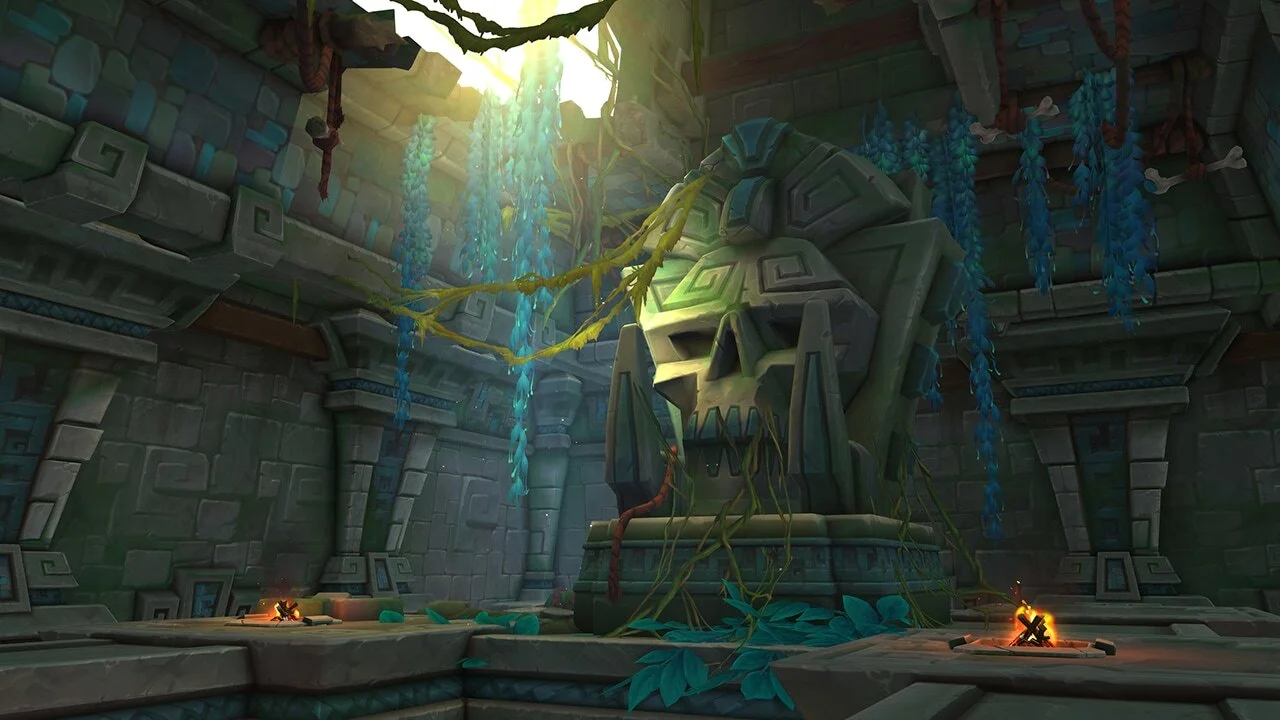
The event is very arcade-y, very face-paced, and it’s time-constrained. You only have 3 minutes to get in there, and harvest, kill, and collect as much as possible. Then, your goal is to contribute that all back to these altars of Dundun — these altars of Abundance — and when you contributed enough, you sort of trigger a bonus like a jackpot. There are a couple of varieties of them, but the idea being that is just an opportunity for you to gain more, collect more, and contribute more. Ultimately, you are vying for the highest scores possible.
There are a lot of different thresholds and a lot of different milestones, so definitely check your achievements. Because that’s where you’re going to get information about maybe certain methods of how you could be approaching it. Now, as far as how it’s different from world quest professions, the only thing that happens outside of those caves is getting a certain kind of charge, that’s called the Shards of Dundun. They’re these things that allow you to do an Abundant Harvest, where you will get the currency for the event.
Now, you can do the event as much as you want. It’s uncapped — you can do it over and over again —but on a rotation, only one Abundant Harvest location is available. You go in there, you give your Shard of Dundun to Dundun, and he hooks you up. And when you’re done, you get a bunch of currency for the vendor. The rewards that you can get from that vendor are wide and various; they’re cosmetic for the most part, but there is also profession reagent (you can only get from here), that allows you to craft some of the highest end of a profession’s gear. And so, it is very fast-paced, and I’m excited to see how high players can get their scores. We’ve seen a lot of pretty high scores in internal testing, but I’m very excited to see, you know, who the greatest acolytes of Dundun are in this event.
Icy Veins: Off the coast of Zul’Aman, there’s a fairly big island with a temple that’s currently shrouded in fog. Does it have a name already, and what are the chances we get to visit in the future?
Jake Shillan: Am I allowed to say what sword at this moment, and just pass?
(Everyone laughs)
Jake Shillan: I will tell you, that…
Icy Veins: Does it start with a ‘Q’?
Jake Shillan: Yeah, right… (chuckles)
Well, I’ll tell you that that island is very dangerous. And, the Amani take great pains to stay away from it as much as possible. If the player attempts to perhaps investigate it, they will probably find they cannot…
Keep playing. Keep enjoying WoW. Because you never know.
Maybe we’ll never go to that island. Maybe we will. We’ll see. 😉
Icy Veins: As far as Prey goes, we think it fits into the WoW ecosystem so well. Was there a specific inspiration that led to the creation of this new system? How did that come about?
Kim Flack: That’s something that a lot of people are interested in, so I’m happy to talk about it!
We did get inspiration from a lot of places, as you usually do with things like this. One of the big ones we looked at were Delves. Of course, Delves were that new system to The War Within. It saw a lot of success; players really enjoyed them because they provided this way for players to engage with instanced content.
Kind of like a dungeon, but not quite in a way that felt like they could play it at their own pace. If you need to get up, take care of the kids, go get a snack… You could come back and not have to worry about the four other people in your group who have gone ahead without you. Maybe they’ve kicked you from the group, or maybe they’re just very upset. You can kind of do it at your own pace, and at your own leisure. Players really enjoyed that.
We saw that they appreciated that freedom, and they also appreciated, not just having that freedom, but still having that sort of scaling difficulty. If you wanted to just do Tier 1 Delve, you can. That’s there for you and that’s awesome. But if you wanted to be pushing to those higher ranks, you might be doing 8’s; 10’s; 11’s… things where it actually starts getting pretty spicy. You have these aspirational layers of difficulty that you have been looking forward to. And players liked the freedom and the progression combined.
So we’re like, “Okay, they like that sort of instanced space. Can we put something like this in the outdoor world, and what would, or could, that look like?” And naturally, since we were thinking about Delves, we started thinking about those big seasonal Delve bosses like Ky’veza — where sometimes, she will just come out and ambush you in the middle of the Delve and you didn’t expect it. This WOAH! moment… It felt very fun and you were excited to do it, even though it was a little spicy. We have all had a couple of deaths to Ky’veza when she decided to come out at the worst time. And players like that as well, and we’re all like, “Okay, let’s maybe use that as a seed. Let’s see if there’s something we can do here.”
Kind of combining that sort of fun moment with those considerations about the outdoor world, like what we can provide in terms of freedom and challenge. And so, that set the vibe and some of the goals for Prey early on… Although then it became its own beast, of course.
Icy Veins: Astalor periodically interrupts your hunts to ask you to engage in some tasks not directly tied to your hunt. These moments are charming in isolation, but over weeks of engagement, they may feel a little bit more like unwanted interruptions. How do you balance designing content for long-term consumption versus the short-term delight for starting something new, especially for something like the Prey system?
Kim Flack: Really great question. And I think it sounds like the moments you’re referring to are the affixes that are mostly present in Nightmare Mode; a little bit less in Hard Mode. And specifically, probably the Affix that’s called Bloody Command where Astalor says, “I want you to kill something in the next 20 seconds. I don’t care what it is, do it. Otherwise, I’m gonna put a giant bleed on you.”
These affixes are definitely intended to feel difficult and kind of like interruptions specifically, because they do demand your constant awareness that they might happen. It’s something we don’t typically ask of players in the outdoor world, of all spaces. But it is something we ask of players in other types of content. For instance: Affixes in Mythic+ or Madnesses in Horrific Visions, if you’ve played a lot of that. (I know I have!)
The affixes in Nightmare Mode’s Prey are different from those two examples, but the underlying sort of idea or philosophy is the same. It’s an extra layer of difficulty that’s going to challenge your moment-to-moment gameplay decisions. You’re going to have to think, “If one of these affixes happen to me right now, do I have something to answer it?”
Specifically to the question, the short-term delight there is the same as a difficult dungeon or raid boss where, the first time you see mechanics, you’re interested because it’s new and shiny. You want to see how it works, and then it probably just killed you. And you’re like, “Woah, that was fun. What just happened?”
You kind of dip into practice mode after that like, “I saw how it worked, and I died to it once. How can I succeed? How I can execute this properly the next time it happens to me?” That kind of leads into, what I would say, is the long-term goal or aspiration of long term mastery. You’ve been introduced to these affixes — especially on Nightmare Mode — where you’re going through this very hard challenge in the first place. You’ve practiced it, and now you’ve “got it”.
Especially for some affixes in Prey specifically, and to a lesser extent, for some of the affixes in Mythic+ and these other places as well… Maybe mastery might look like knowing when your class or your spec — or maybe even your race — has an answer to something. What players might call “cheesing the mechanic”.
For instance, if you get Bloody Command while you’re playing a Paladin, maybe you just go, “I don’t care, give me the bleed. I’m just going to divine shield.” Or maybe you’re playing a dwarf: “I’m just gonna stoneform. I don’t care.” But maybe, if you’re playing something like a Priest, you’re like, “I should probably answer that affix, but I don’t really have something easy to work with.” Maybe your divine shield is on cooldown, and you’re like, “Oh, well. Guess I need to do the affix.”
Or maybe if you get the fixate-ghost, Echo of Predations — it’s another affix on Nightmare Mode, where this ghost is fixating you; if it touches you, you get this giant magical debuff — if you’re a Death Knight, maybe you just AMS and you run into it like, “Yup, that’s how I deal with this. I’m not gonna do the actual mechanic here.”
But really, you are doing the mechanic: you’re just doing it in a way that’s very smart and very present in the moment and in your gameplay. You’re thinking about all the things you have in your toolbox. Basically, I’m presenting you with a problem, and you’re just going, “Oh, I have a different way to solve it that isn’t on the answer sheet”. Well, technically it is. 😉
Icy Veins: So we talked already about the affixes for Nightmare Hunts. Are there any additional abilities or encounter phases that you can expect for Nightmare Hunt targets? And what happens if you fail a hunt on Nightmare? Do you lose progress? Tell us more about that.
Kim Flack: So each encounter on Nightmare Mode is a little different. Also, you do kind of fight the target almost in like two different ways during your hunt. I always split hunts into, what I call, Stage 1 and Stage 2; Phase 1 and Phase 2. I kind of use those words interchangeably; I apologise in advance (laughs).
But that stage or phase 1 being: when you’re hunting them down, you’re doing your gameplay across the zone; you’re doing your prey-specific activity; your routine activities in the zone, trying to narrow down on where they are… You’re kind of filling this bank of hunt progress while you’re doing that. Once you’ve completed phase 1, the quest goes to the next objective and it is “Go kill your target”. That’s like phase 2: the actual final encounter.
When you’re in that first part — when you’re still hunting them down — you’re going to be fighting them through ambushes. And absolutely, their abilities are going to feel a little different between the three difficulties. So like, Nightmare Mode: pretty spicy. They’ve got a lot of health; their abilities might be a little different; they’re stunning you when they come out of the shadows… It almost feels like you’re getting ganked by a Rogue; it’s just this very intense little moment.
And then, of course, the actual final encounter: the meat and potatoes of this system. Each encounter is going to feel a little bit different: on Nightmare, some of the targets do have additional abilities or they have the same abilities but they work differently. Or sometimes, they kind of just have a wombo-combo they do on Nightmare Mode that maybe isn’t present on Normal Mode or Hard.
They hit way harder and they might have crowd control that isn’t present on the other difficulties. Very dependent from fight to fight. All those targets not only have their own narrative personality, but it shines through in the way that they fight and when their abilities come out. And on Nightmare specifically, the level in complexity — the sort of mechanic depth that we were going for — was somewhere in the ballpark of a Tier 8 to 11 Delve boss. Obviously, that’s really rough and kind of hard to map 1 to 1. But that can give you the idea. These are not Dimensius (laughs). These are more towards the higher-end Delve boss idea.
And of course, when it comes to dying on Nightmare… (chuckles)
Everyone’s already worried about this in advance, which I can’t blame them for. 🙂 So like I mentioned that Stage 1 and Stage 2 part of the Prey quest… During that Stage 1, when you’re accumulating hunt progress, if you die on Normal Mode? Doesn’t matter. If you die on Hard Mode? You lose a little bit of hunt progress. If you die on Nightmare Mode? You lose ALL of your hunt progress.
And people will be like “WHOA. What does that mean? What do I do?!” There are always ways to get them back: defeating ambushes; chasing them down after you’ve defeated them; disarming their traps; doing all sorts of activities across the zones that are prey specific or not prey specific — always ways to get your hunt progress back. Just might take you a little bit longer, depending on how many times that you’re dying.
But once you’ve completed that hunt phase — once you’ve figured out where your target is — it doesn’t matter anymore. You can die as much as you like. If you’re just throwing your head against the wall trying to defeat that Nightmare of a boss, the only limit is your repair bill. That’s it. (chuckle) You just keep going back, doing your death run, and just fighting it over and over again until you get it.
Icy Veins: So if a player was going to try and fill their Great Vault’s World Slot with just Prey, what’s the time commitment that they might expect to put into something like that? Is it similar to Delves and can you interrupt a Prey and come back to it?
Kim Flack: I’d LOVE if there are players who are like, “I want to fill my entire vault with Prey.” That’s success, right? And this is a nice and easy question, because I’ve answered this a lot for my friends. 😉
The goal is that the average prey hunt — and of course, this is going to change based on gear and skill and just how feisty you’re feeling that day — but the goal is to take about 15 minutes to complete. So if you’re filling up all slots of your World tier of your Great Vault… That would be, you know, including a little bit of travel time and whatnot, about 2 to 3 hours of gameplay?
I think, at least anecdotally, that is about the same as if you were filling it up with Tier 8 Delves with decent gear… But one of the really great things about Prey is that, you can multitask while you’re doing it. So if you want to go into an instance, experience the delves and kind of knock it out, that’s great for you. But if you wanted to, maybe, do your world quest at the same time as finishing a prey hunt, or you want to do your rare-mob circuit, or pick up some treasures… It’s a great way to kind of multi-task. And just do two birds with one stone.
I mean, it might be a little hard sometimes, when you’ve got Nightmare Mode tossing those affixes at you (chuckles). But maybe you enjoy that challenge. And yes, like the multi-tasking part might imply, you absolutely can interrupt a hunt mid-way through and continue it later. You can do it at any stage: you can do that in Stage 1; you can do that in Stage 2. Like if you’re halfway through Stage 1, you get called away to go do Mythic+ with your guild… You can come back and you’re right where you left off.
Or, if you were in the middle of trying to defeat that Nightmare boss, and you have to go to raid night; or you got to pick up the kids from school… You can come back, walk back in, you can just be fighting that Nightmare boss again, no problem. Very easy to pick up and put down. The one limit that’s important to bring up is that weekly reset.
When your dungeon and raid lockouts would expire on Tuesday mornings (for North America), all your Prey quests do get wiped from your log. The Preys kinda get “powerwashed” from your character on Tuesday mornings, and Astalor will have a new set of stuff to give you. So pick it up, put it down… But just make sure that you get all of your stuff that you want to get done before weekly reset.
Icy Veins: You mentioned earlier that the general goal for the difficulty of Nightmare Prey Targets is around Tier 8 Delves. But will there be a Prey Nemesis boss in the future?
Kim Flack: I mean, we don’t have anything to announce right now, but that’s an interesting idea. Anything is possible in the future. We still want to see: what do players like about prey; what are they engaging with; how are they engaging with it. And that feedback is how we figure out like, “is there stuff that we can change or improve?” So if that’s something that a lot of players ask for, it’s something that we’ll hear. It may (or may not) be something that we can act on.
But absolutely, let us know if those are what it is that you like. And we do have a ton of Prey for you to chew on, right out the gates. So there will definitely be no shortage of Prey targets to be fighting. And really, on Nightmare Mode, those Prey targets kind of feel like Nemesis bosses in their own right.
So if you’re wanting that, definitely go in there, especially on maybe like slightly less geared or maybe a slightly squishier class. You’re going to have a run for your money. (Chuckles)
Icy Veins: Looking forward to finding out, especially as a Rogue. (Nervous laughter)
Thank you very much, Jake and Kim, for the interview. It was a pleasure talking to you, and we hope you and the entire team at Blizzard Entertainment will have a great Midnight launch!