


Every Diablo game has had a defining expansion. Not just adding content, but fundamentally improving the game. Diablo 4 Lord of Hatred may be looking to the past to look forward.
For Diablo II, that expansion was Diablo II: Lord of Destruction.
For Diablo III, that expansion was Diablo III: Reaper of Souls.
Now, the Diablo 4 Lord of Hatred expansion is approaching, and Blizzard may be preparing for a similar turning point.
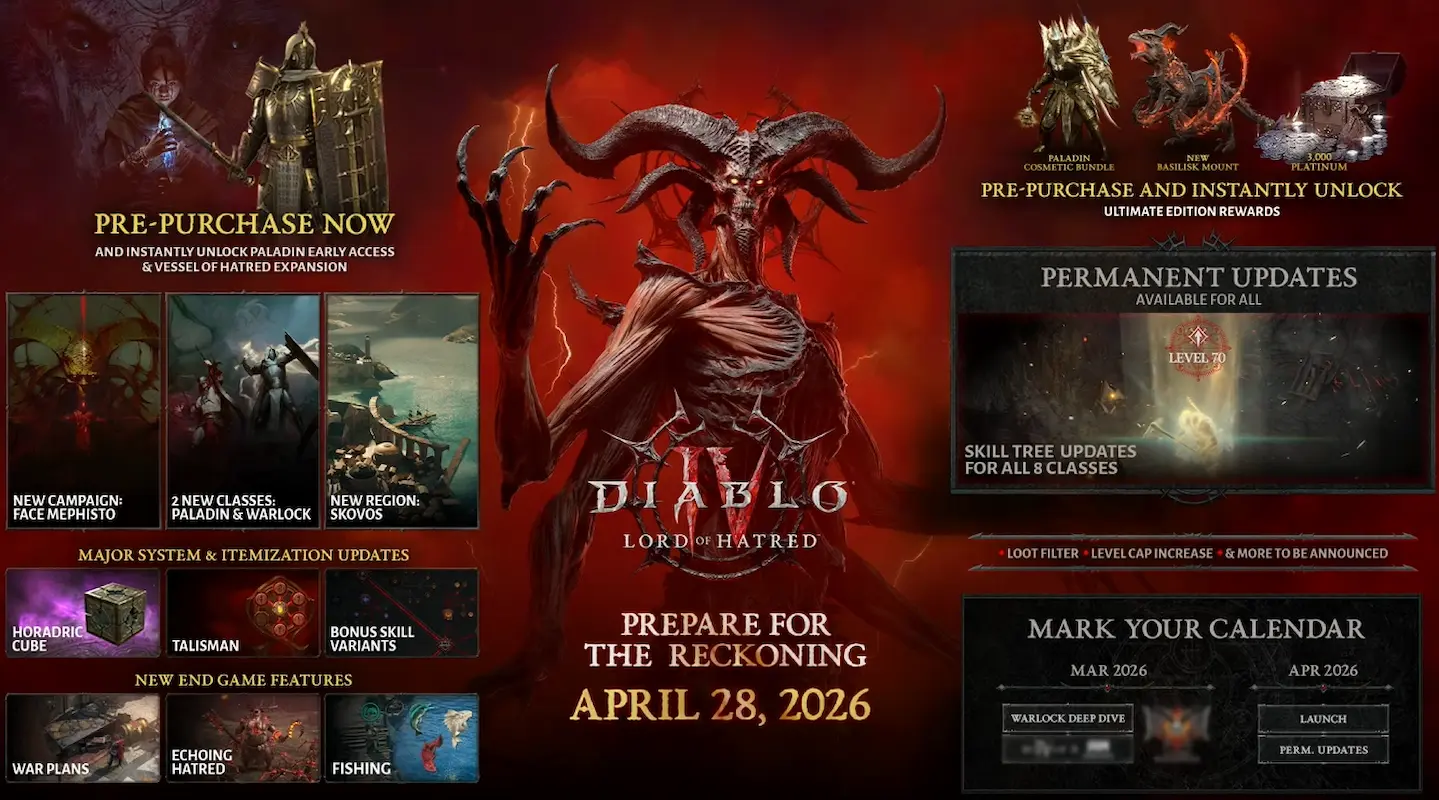
Many of the systems being introduced in Lord of Hatred suggest that Blizzard is aiming for more than just new content. Instead, this expansion is focused on deeper progression, improved itemization, and more meaningful endgame systems. For the veterans out there, you might recognize the same kind of changes that helped define previous Diablo titles.
Lord of Destruction Changed Diablo 2
When Lord of Destruction launched in 2001, Diablo 2 was popular, but the expansion took it to another level.
Lord of Destruction introduced:
- Two new classes (Assassin and Druid)
- A full new Act (Act V)
- Charms and deeper character customization
- Expanded itemization and runewords
- New endgame farming opportunities
These are the changes that helped turn Diablo 2 into the long-lasting ARPG that players still return to today. The expansion gave depth, more build variety, and more reasons to keep playing.
More importantly, Lord of Destruction gave us long-term progression goals. This became a core part of Diablo’s identity and ARPGs moving forward.
Reaper of Souls Saved Diablo 3
Meanwhile, history repeated itself with Reaper of Souls.
At launch, Diablo 3 struggled with several major issues such as:
- The Auction House dominated progression (and yes, we can’t forget the real-money Auction House)
- Loot felt unrewarding
- Endgame content was limited
- Build diversity was restricted
However, Reaper of Souls addressed many of these problems head-on.
The expansion introduced:
- Adventure mode
- Greater Rifts
- Loot 2.0 itemization changes
- The Crusader class
- Bounties
As a result, these changes dramatically improved Diablo 3’s gameplay loop and reshaped the game into the version we know today.
Lord of Hatred Could Be Diablo 4’s Turning Point
Now, have you started to notice the pattern? Blizzard has already revealed several major systems coming with the Diablo 4 Lord of Hatred expansion, including:
- Two new classes (Paladin and Warlock)
- New endgame progression systems
- Expanded crafting
- Skill tree reworks
- The return of the Horadric Cube
For longtime players, the Horadric Cube represents more than nostalgia. It signals deeper item manipulation and long-term progression. Something many players have been asking for since Diablo 4 launched.
Looking Back to Move Forward
Each Diablo expansion that reshaped its game was focused on the same core idea: deeper progression and stronger endgame systems.
- Lord of Destruction expanded Diablo 2’s depth
- Reaper of Souls reworked Diablo 3’s progression
- Lord of Hatred may now be aiming to refine Diablo 4
We will soon see how impactful Lord of Hatred will be for Diablo 4. But the direction Blizzard is taking by bringing back classic systems like the Horadric Cube and expanding endgame progression is trending in the right direction.
If that’s the case, Lord of Hatred could help define the game’s long-term future.