We sat down with Lead Encounter Designers Andrew De Sousa and Taylor Sanders to talk about Patch 12.1, Midnight Season 2, addons, and encounter design. We were joined in the interview by Wowhead and Raider.io.
In the interview, we had Seliathan from Icy-Veins, Sean from Raider.io, and Squishei from Wowhead.
Check out the full interview video from Raider.io below or our transcription at the end of the article. Here’s the Wowhead coverage of the interview.
Interview Highlights
Add-ons and Information Access
- Starting in Patch 12.1, add-ons can no longer directly access Aura information. Blizzard has separated what data add-ons can read from the ability to display it in custom ways.
- The goal is to put computational add-ons fully to rest. This is intended so new or returning players don’t feel obligated to download a large add-on package just to play the game.
- Information asymmetry and hidden-information mechanics are back as a design space, with a few already on the PTR in the Venomous Abyss.
- The Entombed Sentinels’ debuff-matching mechanic is a direct example of something previously offloaded to add-ons.
- Nothing to announce on replacement tools for raid leaders or accessibility, but Blizzard says it wants to hear ideas.
- No current plans to let add-ons hook into the new missed-kick tracking.
Raid Structure and Design
- Season 2 uses a two-instance raid tier: an eight-boss Venomous Abyss plus a one-boss Tidebound Grotto.
- The Grotto is meant to recapture the bite-sized raiding that pugs and shorter play sessions found success with in Season 1.
- Raid trash is still in the raid. Non-standard gameplay is a deliberate callback to moments like the Naxxramas Frogger hallway and the Blackwing Lair trap room.
- Larger, more vertical boss arenas are deliberate but not a philosophy shift. Queen Ansurek’s verticality was built to sell the climb up her web.
- More two-target cleave in this tier reflects the raid’s theming, not a change in direction.
Class Utility
- On abilities like Gorefiend’s Grasp and Abom Limb, the goal is that other classes can back into the same outcome less efficiently, knockbacks, Ring of Peace, rather than one class holding a solution nobody else can approach.
- “Are they as efficient as Gorefiend’s Grasp? Absolutely not.”
Tuning and Difficulty
- Season 2 gets a system similar to Void Spire, Dream Rift, and March on Quel’Danas that ramps player power weekly, resolving after Race to World First and the Hall of Fame.
- Blizzard defaults to buffing players over nerfing bosses. Nerfs are reserved for reaction-time and mechanical asks, like the L’ura glaives.
- “It’s not necessarily a great feeling to show up to your raid and have something nerfed and feel like the goal post has been moved.”
Mythic+
- Record Season 1 participation is attributed to accessibility, a strong dungeon pool, and classes being fun to press.
- Keystone Myth and the top 1% mount answered an outspoken appetite going into Midnight.
- No plans for an in-game routing or mapping tool. Lindormi’s guidance targets the entry point; advanced routing is left to community tools. The door isn’t closed forever.
- Dungeon trash has had a simplification pass since War Within Season 3. This resulted in fewer cast bars, less visual noise, and cut rider effects.
- Hard knowledge checks are intentional, with the onus on Blizzard to telegraph clearly.
- Cone visuals were updated so the visual language reads immediately without an add-on alert.
Full Transcript
Note that the transcript may contain errors and speech artifacts. We’re cleaning it up as we go, so come back later if any mistakes are found!

Website Group Interview
Andrew De Sousa: Hey. I’m Andrew de Sousa. I’m a lead encounter designer for the World of Warcraft team. I’m responsible for dungeon, delve, and raid content really anything you can fight but my primary focus is on dungeons and mythic+.
Taylor Sanders: Hey my name is Taylor Sanders. I’m also a lead encounter designer on the World of Warcraft team. and yeah here to talk about all things PVE season two dungeons, delves, raids, and the like.
Icy-Veins: Coming out of the three-raids raid tier, what were some of the lessons that you learned and what the community particularly liked about it? And are there some changes with this raid tier or maybe in the future that are a bit of a direct consequence of the community reception of having a split raid tier again?
Taylor Sanders: Yeah, so… going into Midnight I think we really wanted to follow the story with where the events of the world were going and that’s something that drove us to that split raid tier. [It is] something we’ve had in the far past now of World of Warcraft’s history, but we haven’t had in a while. One of the things that I think we saw that came out of that was pretty positive is some of the separation of raid content in a way that maybe you don’t have an entire night you know to raid or you have like a shorter play session and players are still able to go in and have quite a bit of success tackling things like the Dreamrift, for example, there’s some good loot in there, which helps, but I think we saw a lot of pug groups and a lot of smaller groups or non-organized or guild groups able to go in there and get a bite size of raiding into their week. We liked that a lot. and that’s one of the things that drove us into creating a two instance raid tier with the Curse of Ula’tek update. We’re going to have an eight-boss raid releasing with Venomous Abyss and a one-boss raid in the Tidebound Grotto. And we’re hoping that the Tidebound Grotto can capture some of that small, more bite-sized raid size that we saw a lot of success with in Midnight.
Wowhead: So I wanted to ask a question about Mythic L’ura. Third-party tools became almost expected to manage the memory game. What lessons did the team take forward into designing Ula’tek and the Venomous raid?the Venomous Abyss sorry yeah.
Taylor Sanders: With the addon changes on Midnight I think there’s still a lot to iterate on and improve on. Overall we’re feeling pretty positive about and what the general experience is like for players. One of our major goals was to make sure that if you’re returning to WoW or you’re a new player especially, that you don’t feel obligated, at least when you start playing the game, right, to like download this huge package of addons just to be able to function. And the other is to eliminate computational addons. There were still a few that I think especially our high end of Mythic players felt obligated to use in the launch raids. But starting with 12.1, addons can no longer directly access Aura information. We have separated out what type of information can be accessed by addons with the ability to display that information in custom ways, which is something we’ve always tried to maintain in this sort of like quest to remove some computational addons from the game. So we’re hoping with some of these back-end technology changes, that computational addons can fully be put to rest, and that we can let some of these mechanics that we’ve been designing that are more based on hidden or asymmetric information, that players can have more of what the intended experience is, which is creating a strategy or a communication strategy within their own group to overcome them.
Wowhead: Awesome. A quick follow-up there. Can we expect to see more mechanics use information asymmetry in the future? It’s been a while since we’ve seen that since I think Mekkatorque was the last time we saw that.
Taylor Sanders: Yeah, absolutely. This is… When we talked about the addon changes in Midnight as an encounter design team, we talked about a few different areas of where we might go with things that we haven’t been able to comfortably bite off for a while as a design space. And information asymmetry or hidden information is one of those areas. So we’re experimenting with it in a few ways that I think players have seen on PTR in the Venomous Abyss, on a couple different raid encounters at least. We’re going to continue to experiment there. We’re going to continue to listen to player feedback on whether that’s the type of thing that players like in modern WoW raiding. But we think there’s some fun gameplay there. We’re experimenting with it again, as I said, in the Venomous Abyss. And we’d love to hear players’ feedback once they’re done with the raid tier.
Raider.IO: Certain class abilities, let’s say Deathgrip, have become defining parts of raid strategy on several recent end bosses. How does the team decide when a class-specific utility should feel rewarding versus becoming effectively mandatory?
Taylor Sanders: Yeah, so I think one thing we always try to endeavor for is DK is a great example, right? So we try to make sure that… when a class has a utility button that’s seen as very. transformative or very powerful such as Gorefiend’s Grasp, an Abomination Limb / Death Grip style mechanic that there’s also other ways to achieve that, that maybe aren’t as efficient or aren’t as powerful, but there’s other ways of accomplishing that problem like with knockbacks, Ring of Peace, all of these types of like monster movement mechanics. Are they as efficient as Gorefiend’s Grasp? Absolutely not. but I think that’s a key differentiating factor, can other can other classes do a form of that utility. Because ultimately we want those spells to feel very impactful, we want them to feel like powerful assets you bring to your raid. That’s what makes classes sing in World of Warcraft, but I think there’s a big difference between a class that brings the thing that no one else can hope to even echo in a less powerful way, a spell that is the best of its form, that other classes can sort of back into with less efficient forms.
Raider.IO: Should I gear up my Blood DK for the final boss of the venomous abyss?
Taylor Sanders: It’s always time, a good time to gear up a Blood DK. a lot of Blood DK in this expansion.
Wowhead: One of the points of feedback from testing was the overwhelming amount of trash in the raid. Have you made any changes to that since testing? or the blood channeling mechanic where you have to sit there with your raid and just channel for like 10 seconds while your healers are healing you?
Taylor Sanders: Yeah, so throughout PTR, we’re always making adjustments to things like this, tons and tons of tweaks to raid trash, to spawning, creature abilities and raid trash, tuning, all that stuff goes under heavy iteration. Especially once things hit PTR, we start getting a lot of feedback that really ups the frequency and intensity of our updates. There’s still raid trash. Sorry to break it to you guys, but there’s still raid trash in the raid. And one thing about the sacrifice altar thing, so one thing we’ve tried to get back into a little bit in raids is some of that non-standard gameplay that has actually defined raids from the very beginning. If you think back to the frogger hallway in Naxxramas or the BWL trap room, those kind of weird non-standard areas of the game that raiding know it’s hilarious to see your friend like die to the frogger thing right like or like you know the dagger in Dazar’alor, right that like could you know kill your friends and stuff like that. those types of mechanics make raids memorable in general. and there’s a few different places in the venomous abyss where we tried to just design something non-standard. Raids are unique in that they’re very social. So you’re in there with a raid group, often your own voice comms. And those types of experiences can make, you know, a raid feel unique as opposed to just like, you know, another space in a video game that’s filled with, you know, red health bars and monsters.
Wowhead: Yeah, I mean, I love the coffin room. So kudos to that room where you have to find the thing. So great job with that one.
Taylor Sanders: That was a lot of fun to make.
Raider.IO: I guess Trial of the Crusader will remain my undisputed favorite raid of all time. We’re talking about trash. I’m going to give Taylor a break. We’re going to jump over to Andrew. Trash is such a large part of the dungeon experience, but it doesn’t have any entries in the dungeon journal. How does the team tackle designing these enemies to be able to convey what a mechanic does?
Andrew De Sousa: It’s a great question. Yeah, there are a lot of creatures to learn in any given dungeon, let alone any given season. And I think as we’ve seen, especially since the War Within Season 3 forward, we’ve taken a big pass on simplicity. in terms of what the mechanics are actually doing, visual noise. We’ve cut clutter. Does this really need a cast bar? Are we signaling the right information? If you’re fighting 10 creatures and there’s 10 gray bars on screen, are you getting a read for that? We’re also looking at just what an ability does, like I mentioned. When we see a bolt, we know what to expect right out of gates. We know what that caster is going to do, how we need to move it, whatever. have you. With spells like some things like debuffs, we might pare some of that back. If it puts a ring on you and it’s going to pulse damage, we should look to where we can cut off what we call rider effects. The game is telling you you should be isolated. As long as you’re doing that, that’s enough for a trash creature. So really just paring down that complexity and making what is mechanically different or distinct have space to stand out and for players to have time to deal with it.
Raider.IO: Okay, just sort of a follow up, still dealing with trash. The implementation of Lindormi’s Guidance was a massively popular decision. Have you ever considered, you specifically, have you considered building a mapping tool into the game to somehow tie that with us being able to plan our own routes?
Andrew De Sousa: Yeah, this is something we’ve talked about a little bit, you know, from time to time. So Lindormi’s Guidance was really targeting like that entry point. or I just I want to try out tanking or I want to take a weekly but I just don’t want to learn all these. you know this routing. when we’re sort of like deciding what’s going to be in the slate of like the base game. Something like a mapping tool is more targeted towards advanced routing, everyone wants to cook a route so to speak, right? Once they’re up and pushing towards top 1% or whatever. The community has really solid public tools for that. [Those] might overwhelm a new tank who Lindormi’s was targeted for to begin with, so no plans right now. But I do think it’s very cool to see what the community’s built up and that’s not to say the door’s closed forever.
Icy-Veins: So player health and creature damage are both up with the patch and simultaneously the class team adjusted the numbers and burst cooldowns down quite considerably while boosting the sustained damage of a lot of the classes to make up for it. How has this affected the dungeon design and tuning? because we’ve now had multiple expansions almost of a meta and mythic plus where massive aoe pulls tied into these like very strong. cooldowns and now that that has been reined in a little bit can we expect the meta to change a little bit more towards sustained DPS as well?
Andrew De Sousa: oh it’s a great question. First off we’re paying very close attention to how players are pushing on PTR. I’m sure if you’re anyone following you’ve seen you know we’re updating almost weekly, communicating that out and it’s interesting to see like the strats and metas that are starting to unfold and I think we’re all aware that what we’re seeing on PTR is not necessarily what’s going to be meta four months from now or whatever. That said, whether it be a raid or a dungeon, we’re always sort of looking to sort of shake up the meta in the way Taylor was talking a moment ago about what we do with raid trash. We think about that with dungeon trash like are there odd opportunities to have this be like, you really just want to smash this pack if you have two target or really good single target or whatever have you? So this is something that we want to try to tackle on the encounter design side, but we’re also paying pretty close attention to how this is playing out both by watching people play live feedback on PTR and like look at internal data.
Wowhead: Given the inclusion of at least one council fight and the rising amount of two-target cleave in the recent raids, are you happy with the shift in raid design moving away from more single target encounters? Is the design direction of classes something that is considered when you’re making these types of encounters for an upcoming raid?
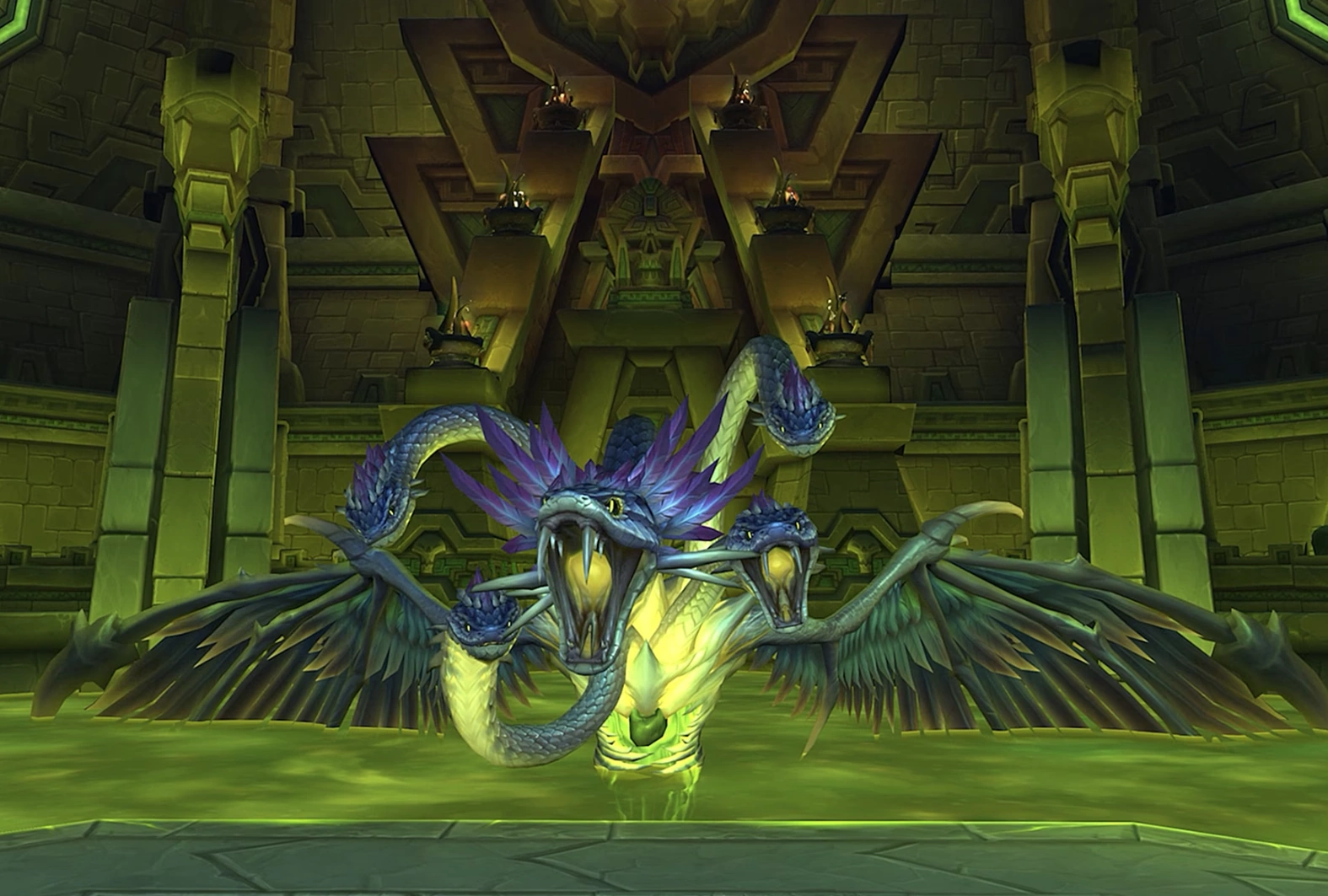
Taylor Sanders: Yeah, so to the latter question, absolutely. We always consider class balance. Our goals as encounter designers, we work very closely with our class design team, but they’re two sides of the coin right? In the way that they make a lot of keys for different problems, we try to make a lot of different locks, so it’s our goal always to make a raid tier and a mythic plus season, a delve season, a whole competitive PvE season of WoW that has a lot of different challenges, a huge variety of challenges. Obviously the back end of the raid has a lot of focus on it for the types of DPS profiles, types of healing profiles, damage profiles that certainly like drive a lot of that as well as like very high level M+, but you know it’s one of our goals to just make sure there is a variety. Just because I think this raid has a little bit more multi-target a little bit two target cleave that doesn’t necessarily drive [the team]. That’s not a reflection I think of a change or a shift in philosophy towards those types of damage profiles for the game in general. sometimes it’s just where the creatures take us. It’s like where the ecology of the things that are fighting take us and this is a raid about like this horrific snake creature spawning, like an enormous army of beasts that float out over the isle. So there’s going to be things or encounters where you feel like there’s swarms of enemies or more enemies attacking you, and that’s, I think, a natural fit to the thematics of the patch. But yeah, overall, we mostly try to just substantiate a good spread or variety of challenges throughout the season so that every class feels like they have their moment or their encounter to shine.
Icy-Veins: So many raids in the past ended up having perpetual nerfs due to either an increasing power gain for players or a renown track that kind of just reduced health and damage of the bosses. Will there be a passive nerf system like that in the Venomous Abyss? And how do you decide as a team in general whether a numerical nerf to a boss will suffice to just make it more accessible to more players over time versus needing mechanical changes like, for example, the glaives on L’ura who got… both reduced in count and I think in the travel speed.
Taylor Sanders: Yeah, this is a really interesting question. So first of all, to answer your question about what system will be coming in Season 2 of Midnight, there will be a similar system to what exists in Voidspire, Dreamrift, and March on Quel’Danas. that will slowly nerf the raid over time. Or rather, buff players, I should say, more specifically. So that every week, you feel like you have a leg up from the week before, so to speak. And after a few weeks have passed, really for the Race to World First and other hyper-competitive events like the Hall of Fame to resolve. So expect something similar to what you saw in Season 1 of Midnight. More broadly, to the philosophical question that you asked about, is it better to buff players or nerf bosses? They’re both tools in our toolkit. In general, we try to default to focusing the power on the players. They’re the heroes of the story. They’re the adventurers in Azeroth. If we can give you a new tool or something new in your hands to make you feel more powerful, especially if that’s obtained in a cool way, then we’re going to default to that to make you feel like you’re overcoming the challenge. Necessarily [it is not] a great feeling to show up to your raid and you know have something nerfed and feel like you know the goal post has been moved so we try to avoid that as much as possible. In cases like the L’ura glaives is a good one. It’s very difficult to to make a change that is going to buff the player to help them, be more able to react to those glaives, right? That’s much more about human reaction time, human player skill. And so that’s a place where we would default to nerfs, something that’s much more mechanical or much more twitchy in terms of the ask that we’re requiring of players as opposed to like a simple throughput check or a gear challenge.
Raider.IO: Perfect. Did you design the glaive? I just need to update my Christmas card list, and I just need to know who to take off. Did you design the glaive?
Taylor Sanders: Glaives were a team-wide decision to try to murder as many players as possible.
Raider.IO: It worked.
Icy-Veins: Success. They succeeded. We did it.
Taylor Sanders: Yeah, we got them. Incredible.
Raider.IO: I always love finding out how the team assesses stuff. So Season 1 saw some of the highest Mythic Plus participation numbers in the history of the game. What does the team attribute to the popularity internally?
Andrew De Sousa: I think our main driver there is accessibility. What we’re seeing here, right, is players felt like they could jump in, they could start farming some hero pieces, like 10s were in reach, and then suddenly 12s are in reach, and suddenly 14s are in reach, right? And that’s why we ended up implementing, which we had wanted to, had talked about doing for a long time, like Keystone Myth and that top 1% mount. It’s like… We knew we wanted to do it, and there was a very outspoken appetite for it going into Midnight Season 1. So for us, I think it’s accessibility. I think it’s just a strong dungeon pool. Pressing your buttons is fun. I think a lot of classes turned out really fun in Midnight. So we’re really happy to see the participation right now. It’s making me nervous just watching the top 1% final scores tick up every day, but it’s also exciting to see people in there.
Wowhead: All right, kind of on the idea of accessibility. We’ve seen. an increase in Midnight dungeons on pure knowledge checks. You need to know how to do this mechanic or else you and probably your group dies. For example, in Altar of Fangs, the second boss, all five players need to pull the tether or the last boss where four players need to soak the beams or you just die. Is this intentional? And are you okay with a group wiping due to one player not knowing the mechanic in a five player dungeon?
Andrew De Sousa: At the end of the day, this is co-op PvE, right? So we want, for some mechanics, at least like a central theme, like the mechanic you’re mentioning at the end of Altar of Fangs or the second boss. We have, like I mentioned, what we call, whether it be an LFR boss or a Mythic End boss, there’s oftentimes the one thing you need to know how this works. The onus is on us to make sure that there’s either very clear telegraphing or very clear signaling that you’re failing, if you’re missing a soak. Is there a nova pulsing all over your screen telling you like something is bad you? should address that. I think another example of like a technique we’ve been doing recently is something like the Chief Corewright Kasreth in Nexus-Point. There’s the whole beam cutting mechanic. we did a technique there where like when that aura is on you we hint that you should look at the beams, so we’re looking for those sorts of techniques, but that said if there’s like a central core ability that we we really want you to learn that’s part of the mastery of World of Warcraft for us. This boss puts out this challenge or this this moment and we need to execute and then you’ve learned that moment, you’ve mastered that, and we can shift your focus over to maybe a more advanced strategy referencing that same boss at the end of altar, if we’re in a high key how are we going to manage getting rid of stacks or the dexterity challenge of dodging axes that sort of thing.
Wowhead: Quick follow-up to the second boss. Can Priest outrun that grip yet? Or is that in the works?
Andrew De Sousa: Yeah, so we actually made some tuning adjustments there a couple weeks ago. So your Priest friends will make it. I think this is an example of what we talked about earlier with, like, Death Grip, for example, where it’s like, we want you to hit a button and sort of, like, break that or handle that mechanic as quickly as possible, but within reason, right? And we saw our Priest friends being left behind.
Wowhead: Perfect. Thank you.
Raider.IO: That was a soundbite option for you to say we recommend you don’t bring priests to the altar.
Andrew De Sousa: Just lifegrip the boss away? I don’t know. Yeah.
Icy-Veins: While obviously the boss design itself matters a lot, the arena itself also is quite impactful and often overlooked and over the last couple of expansions, raid boss arenas have been getting quite large or sometimes even using multiple Z-levels for mechanics like Queen Ansurek. Has it posed any specific design challenges when it comes to just looking at how much mobility all the different classes have? And how do you manage to try and keep both melee and ranged specializations feeling like they’re contributing to the group’s success?
Taylor Sanders: Yeah, so yeah, there’s. a lot there. So I don’t think it necessarily represents a shift in design philosophy to have like larger rooms, but it absolutely is deliberate. When we try to create a room that’s interesting, like the example you use in Queen Ansurek, where there’s a lot of verticality that was very deliberate. right she’s a a spider queen right we want to make sure your feel you feel like you’re climbing up that web you know and you’re like in her own environment. without too many spoilers for Ula’tek, you’re going to feel very similarly. You’re in this very interesting environment. There’s venom waterfalls, and it’s going to be pretty interesting. We always try to find ways to engage different movement utility. Players have a huge variety of different types of utility spells available to them, so that’s always a nice… design vector to design towards. And, you know, Ula’tek will be no exception. So, yeah, it doesn’t necessarily represent a design shift for bigger arenas, but we take every opportunity where we can to collaborate with, you know, our DungeonArt and Worldbuilding teams to make interesting environmental challenges because, yeah, there. are so many, you know, buttons available for players to, like, navigate through their environments more dynamically.
Raider.IO: This is actually for both of you, so jump in here as you see fit, but I’m leaning towards Andrew because I have feelings. With the continued evolution of the default UI and more limitations on third-party addons, how has that changed? how the encounter team thinks about communicating mechanics and the information players need during a fight? from understanding possibilities to coordinating? here’s why I’m leaning towards Andrew, coordinating interrupts and crowd control.
Andrew De Sousa: Yeah, philosophically on our side of the house here right when it comes to like encounter and I think that’s something we felt we saw through like Midnight beta testing and we’re seeing in PTR here is we’re a little bit more conscious of access to what like a default UI, or rather, like the average group is going to have access to whether it comes to interrupts so we’re a bit more cognizant of how many interrupts might end up in a given pull or like in a PUG. We’ve also taken more strides to cut back on some of the noise. If we want a spell to be important we have that new UI element where you know it lights up and it glows we’re actually experimenting. I think you might have seen some of these in PTR of like a newvfx asset that sort of like pulses on the creature to show you something important is happening, just trying to make that as clear as possible in the base game for you and from our from our side when it comes to design right it’s like I mentioned making space for those mechanics making it very clear what the most important thing is on screen and in general pulling back on both pacing and coordination were where reasonable.
Raider.IO: Are you implementing a new way to see missed kicks? are we gonna be able to hook into that to make a proper interrupt tracker?
Andrew De Sousa: I don’t know necessarily if there’s any plans for that.
Andrew De Sousa: to be seen
Icy-Veins: With the addon changes, we obviously saw the removal of several useful tools for raid leaders, as well as tools that were really helpful for accessibility purposes. And after a full tier of dungeons and raids, of adjusting to this new environment, many players still consider the tools that they still have at their disposal somewhat wanting. Is there any good news that you can share with the community that might improve the situation, especially on the accessibility side?
Taylor Sanders: I don’t think anything specific to share today, but one of our goals I can say in general for all of our addon changes that we made in Midnight was to try and not impact accessibility or try to impact accessibility as little as possible in the earnest pursuit of removing computational addons and the effect that it’s had on the game. We also know Raid Leaders are oftentimes players who are very devoted, who are driving large social groups to get together week after week. So we have nothing to announce right now or or talk about directly for tools for them. but we want to continue to listen to feedback and if they have ideas for for tools or things that they could be they think will be useful for the game. Our ears are always open and we want to make sure that we’re servicing that crowd as we continue to iterate on kind of a brave new world of an addon-less world, or at least computational addon-less world in Midnight.
Wowhead: On the topic of computational addons, are there any mechanics specifically in Season 2 that you feel like you couldn’t have done with them existing?
Taylor Sanders: Yeah, so I think we’ve always felt okay to do a variety of different mechanics, but I think it does allow us a little bit more breathing room or a little bit more comfort in knowing that players are going to interact with mechanics in, frankly, a more fun way than they have in the past. So one mechanic is the mechanic on the Entombed Sentinels, which is kind of like their ultimate mechanic, where they put debuffs over players’ heads. This is a place where it’s actually a good example of where we have sort of doubled down on more accessible visual effects in places where we kind of would have figured in the past that players have addons for this type of thing, and we sort of have to design towards that at the most competitive of levels. But yeah, this is a mechanic that essentially for players who don’t know, puts a number of debuffs essentially over your head and you have to find your matching player. And that’s just something that would have been sort of offloaded to computational addons in previous expansions. But now in Midnight, we can pretty reliably…rely on players to you know have to solve that in a more emergent you know dynamic real-time way. so it definitely makes us more comfortable designing those things knowing that players are going to have more of our intended experience.
Andrew De Sousa: By design we try to. We don’t necessarily have the types of mechanics you’d see in a raid where they’re at that level of complexity. Like I mentioned earlier, it’s been more so on design technique, on giving people more time. Some of those visual techniques I mentioned earlier with giving players cues on how they should handle a mechanic, like having a trap light up before the boss charges or changing beam states, that sort of thing. And while not directly driven by it, it also influenced some of our decision into updating cone visuals. In a world where you’re not going to get an air horn saying, this is a tracking cone. The dragon moves. We wanted just a clear visual language that tells you immediately how that creature is going to behave.
Wowhead: Awesome. Thank you so much.
Raider.IO: Both of you assume raiders can do math, and that you don’t think I will just wiggle to see if my cone moves.
Icy-Veins: Listen, it’s 2 plus 2, all right? Taylor Sanders: That’s all we’re asking. Sometimes 1 plus 3, all right?
Andrew De Sousa: Only numbers I’m looking at are on the meters, okay?
Taylor Sanders: We’ll escalate to calculus later. Let’s start with simple addition.
Raider.IO: Excellent. That’s all of our. time, gentlemen. I personally am ready for the Taylor and Andrew biweekly dev podcast. So Blizzard, if you’re listening and you are literally in the room, maybe make that happen. But thank you guys so much for taking the time to talk to us today.
Taylor Sanders: Of course. Thanks for having us. Likewise.
Andrew De Sousa: Had a good time. Thanks.